Khawaja
Moinuddin Chishti was born in 1141 and
died in 1230 CE, also known as Gharib Nawaz , is the most famous Sufi saint
of the Chishti Order of South Asia. He was born in 536 A.H./1141 CE, in Sajistan,
Khorasan (other accounts say Isfahan) in Persia. He was a direct descendent of
the Prophet Muhammad.
IIN ARTICLE
He
was one of the most outstanding figures in the annals of Islamic mysticism and
founder of the Chistiyya order in India.
Khawaja
Moinuddin Chishti visited the seminaries of Samarkand and Bukhara and acquired
religious learning at the feet of eminent scholars of his age. He visited nearly
all the great centers of Muslim culture, and acquainted himself with almost every
important trend in Muslim religious life in the Middle Ages. In 1220 he became
the disciple of the Chishti Khawaja Uthman Harooni. They traveled the Middle East
extensively together, including visits to Makkah and Medina.

VERTICAL
Moinuddin
Chishti turned towards India, reputedly after a dream in which the Holy Prophet
told him to do so, and, after a brief stay at Lahore he reached Ajmer where he
settled down. There he attracted a substantial following, acquiring a great deal
of respect amongst the residents of the city. Today, hundreds of thousands of
people, Muslims, Hindus and others, from the Indian sub-continent assemble to
his tomb on the occasion of his urs (death anniversary).
He
apparently never wrote down his teachings in the form of a book, nor did his immediate
disciples do so. But he laid the foundations of the Chishtiyya order in Ajmer,
India, where common people flocked to him in large numbers. His firm faith in
Wahdat al-wujud (Unity of Being) provided the necessary ideological support to
his mystic mission to bring about emotional integration of the people amongst
whom he lived.
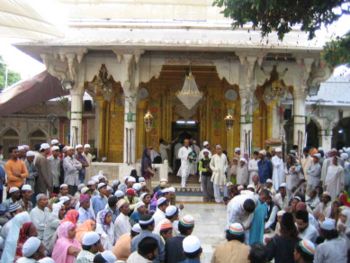
Khwaja Moinuddin Chishti
link
The
central principles that became characteristics of the Chistiyya order are
based on his many teachings and practices. They lay stress on renunciation of
material goods; strict regime of self-discipline and personal prayer; participation
in Sama as a legitimate means to spiritual transformation; reliance on either
cultivation or unsolicited offerings as means of basic subsistence; independence
from rulers and the state, including rejection of monetary and land grants; generosity
to others, particularly, through sharing of food and wealth, and tolerance and
respect for religious differences.

Sama Gathering at brother Salman's
Chisty Manzil
He,
in other words, interpreted religion in terms of human service and exhorted his
disciples "to develop river-like generosity, sun-like affection and earth-like
hospitality." The highest form of devotion, according to him, was "to redress
the misery of those in distress - to fulfill the needs of the helpless and to
feed the hungry."

Sama Gathering at brother Salman's
Chisty Manzil
It
was during the reign of Akbar (1556 - 1605) that Ajmer emerged as one of the most
important centers of pilgrimage in India when the Mughal Emperor undertook an
unceremonial journey on foot to accomplish his humble wish to reach the place.
The Akbarnama records that the emperor's interest was first sparked when he heard
some minstrels singing songs about the virtues of the holy man who lay asleep
in Ajmer. Emperor Akbar was a Sufi mystic who firmly believed that all existence
is one, and that love of God and one's brethren was more important than narrow
religious rituals.
Khawaja
Moinuddin Chishti authored several books including 'Anis al-Arwah' and 'Daleel
al-Arefeen' both of them dealing with Islamic code of living.

Buland Darwaaza & Bazaar
Street in Ajmer, A wood Engraving, 1878
Khawaja Qutbuddin Baktiyar Kaki (d. 1235) and Hamiduddin Nagori (d. 1276) were
Khawaja Moinuddin Chishti's celebrated Khalifa or disciples who continued transmitting
the teachings of their master through their disciples, leading to the widespread
proliferation of the Chistiyya order in India.
Among
Khawaja Qutbuddin Baktiyar's prominent disciples was Fariduddin Ganj-i-Shakar
(d. 1265), whose dargah is at Pakpattan (Pakistan). And Fariduddin's most famous
disciple was Nizamuddin Awliya (d. 1325) popularly referred to as Mahboob-i-Ilahi
(God's beloved) whose dargah is located in old Delhi.
From
Delhi, the disciples branched out to establish dargahs in several regions of South
Asia, from Sindh in the west to Bengal in the east, and the Deccan in the south.
But from all the network of Chishti dargahs Ajmer dargah took on the special distinction
of being the 'mother' dargah of them all.
Nearest Airport: Jaipur-138
Km
Railway Station: Ajmer
----------------------------------------------------------------------------
Hazrat
Khwaja Fakhruddin (R.A.) - Sarwar Sharif :
was the eldest son of Khwaja Sahib (R.A.) who earned his livelihood by farming
in Mandal town. He was a great saint and a scholar as well.

After
twenty years of Khwaja Sahib. (R.A.) death he died in Sarwar town, some 40 miles
away from Ajmer. His Mazar is located near a pond in the town. His Urs is celebrated
on the 3rd of Shaban every year with great fervour. He was blessed with five sons.
One of his sons, Hazrat Khwaja Hussamuddin was a perfect Sufi. His grave is at
Sanbar Sharif. Every year on 13 and 14 Rajab Urs is organised.
To
Reach Sarwar Sherif You can take a ST bus from Ajmer Bus Stand which is 15 minutes
away from the Dargah. or you can hire a Sumo. There is regular Bus after every
half an hour from Ajmer to Sarwar. It take around two hous to reach Sarwar.
Click
here for complete gallery
----------------------------------------------------------------------------

Syed
Meeran Husain (R.A.) - Taragard Fort It
is a grand fort, located on a steep hill in south of Dargah Sharif, The height
of the hill is 800 ft. During the reignof Rai Pithora, it was a famous and a strong
fort and was considered it cannot be conquered. But Sultan Shahabuddin Ghauri
conquered it without any difficulty and appointed Syed Meeran Husain (R.A.) as
the Garrison Commander (Qiledaar).
During
the reign of Qutubuddin Ebak, Syed Meeran Husain (R.A.) was the Garrison of Taragarh
Fort. He also live in the fort. While playing polo in Lahore, Sultan Qutubuddin
Ebak fell down from the back of the horse and died. As soon as the news of his
death reached Ajmer, the Thakur and Rajput landlords of adjoining areas jointly
launched a night atack on Taragarh and entered the fort It was totally dark and
the Muslims were sleeping unaware. Most of them were slashed. rest of them were
awaken in a panic and started resisting.
But
they were smaller in number than the powerful enemy. at last they all were martyred.
the enemies fled before the break of the day. Meeran Husain Khatak (R.A.) was
also martyred in the attack.
When the Muslims of the city heard the
news of the bloodshed there was a mass mourning. Knowing about the tragedy, Khwaja
Gharib nawaz visited the fort with his followers and after the Namaz-e-Janaza,
burried the martyres of Taragarh. Presently the ruins of the fort are left, but
however everyone visits the Dargah of Hazrat Meeran Husain Khatak (R.A.) to pay
the tributes.
Hazrat
Meeran Husain (R.A.) was a great abstemious saint. He mostly used to be at the
service of Gharib Nawaz (R.A.) as a staunch follower. His Urs falls on 17th and
18th Rajab every year.
Click
here for complete gallery
----------------------------------------------------------------------------
The
Mazar of Bibi Hafiz Jamal daughter of Khwaja Sahib,
is situated to the south of the Shrine. There is a small dome with a kalas on
top of it. The doors of this tomb are plated with silver.
----------------------------------------------------------------------------

Mark
from Poland and a friend from Bombay going to the Ziyarrah
of
Khawaja Moinuddin Chishty (ra) with Syed Salman Chishty in
Ajmer Sharif
----------------------------------------------------------------------------
Hazrat
Sufi-E-Basafa Sufi Shahbaz Ali AL Quadri Chishty R.A.
Ajmer, Rajasthan


For
any Assistance in Ajmer pls call :
Qazi Syed Sajjad Ali Chishty S/o Late Mohammed Ali Sb.
Ali House, H.No. 123/5, Anjuman Gali, Ander Kot, Dargah Sharif,
Ajmer 305001 (INDIA)
Rajasthan
,India. Cell # + 91-9829287145
Syed
Salman Chishty S/o Late S. M. Usman Chishty
Chishty
Manzil ,Jhalra Street ,Dargah Ajmer Sharif ,
Rajasthan
,India. Cell # + 91-9829174973
Email - salmanchishty@hotmail.com
For
Complete Information Pls Visit : http://www.kgn786.com


