|
Medina
Gallery - Unseen Pics of Gumbad e Khizra, Doors, Roza Mubarak,
Sunehri Jaaliyaan, Terrace and Many many more pics

KNOW
more about RasulAllah
Stories
of Prophet Mohammed (peace and blessings be upon him)
:: Stories
of Hazrat Imam Ali
Home
of our Prophet

Allah's
Apostle (p.b.u.h) said, "We (Muslims) are the last (to
come) but (will be) the foremost on the Day of Resurrection
though the former nations were given the Holy Scriptures before
us. And this was their day (Friday) the celebration of which
was made compulsory for them but they differed about it. So
Allah gave us the guidance for it (Friday) and all the other
people are behind us in this respect: the Jews' (holy day is)
tomorrow (i.e. Saturday) and the Christians' (is) the day after
tomorrow (i.e. Sunday)."

In
Topkapy museum, Turkey, this box contains the soil from the
Qabr-e-Anwar (grave)
of Prophet Muhammad (peace be upon him).
The
Biography of Prophet Muhammad (PBUH)

Prophet
Muhammad’s (peace be upon him) birthplace in Makkah. Saudigovernment
converted the place into a Library. Recently, Saudi’s has
announced that they will be demolishing this holy site and replacing
it with a high rise hotel / shopping centre.

The
Footprint of Allah's Messenger, Muhammad (Peace be upon him)
safely preserved in Topkapy museum of Turkey

A
letter from Prophet Muhammad (Peace be upon him) to one
of the Arab rulers.
1. When was the Prophet Muhammad (p.b.u.h.) born?
He
was born on Monday,12th Rabi Al Awwal.
2. Where was the Prophet Muhammad (p.b.u.h.) born?
In
Makkah
3. What is the name of the Prophet's father?
Abdullah
Ibn Abdul Muttalib.
4. What is the name of the Prophet's mother?
Aminah
Bint Wahhab Ibn Abd Manaf Ibn Zahrah.
5. When and where did his (prophet's) father die?
He
died in Makkah before Muhammad (p.b.u.h.) was born.
6. What is the name of the Prophet's grandfather?
Abdul
Muttalib.
7. What was his granfather's position?
He
was the chief of his clan Bani Hashim.
8. What is the Prophet's (p.b.u.h.) lineage up to his fifth
ancestor?
He
is Muhammad Ibn Abdullah Ibn Abdul Muttalib Ibn Hashim Ibn Abd
Manaf Ibn
Qusai Ibn Kilab.
9. Who suckled the Prophet Muhammad (p.b.u.h.)?
First
Thuyeba, the freed slave girl of his uncle Abdul Uzza known
as Abu
Lahab, then Haleema Bint Abu Dhuaib, best known as Haleema Al
Sadiyah.
10. Who named the Prophet Muhammad (p.b.u.h.)?
Abdul
Muttalib.
11.
What did Muhammad's (p.b.u.h.) mother name him?
Ahmad.
12. Why did she (the Prophet's mother) choose this name?
Because
she saw an angel in a dream calling the new-born baby Ahmad.
13. How old was Muhammad (p.b.u.h.) when his mother died?
Six
years old.
14. Where did his mother take him?
She
took him to Yathrib (Madinah) to visit her relatives.
15.
Where did his mother die?
On
her way back to Makkah, she died at Abwa and was buried there.
16. Who brought Muhammad (p.b.u.h.) back to Makkah?
His
father's slave girl, Umm Aiman (May Allah be pleased with her).
17. Who took the charge of his care?
His
grandfather Abdul Muttalib.
18. How long did The Prophet's grandfather take care of the
Prophet
Muhammad?
For
two years.
19.
How was his (Abdul Muttalib's) behavior with Muhammad (p.b.u.h.)?
He
loved him very much and preferred him to his own sons.
20. What did Abdul Muttalib foretell about his grandson?
That
he would hold a prestigious position.
21.
Who took care of the Prophet (p.b.u.h.) after the death of Abdul
Muttalib?
His uncle Abu Talib.
22.
How old was Muhammad (p.b.u.h.) when his grandfather Abdul Muttalib
died?
About
eight years old.
23.
When did Muhammad (p.b.u.h.) travel to Syria and with whom?
He
went to Syria with his uncle Abu Talib when he was twelve years
old.
24. Who was Khadijah (May Allah be pleased with her)?
She
was a wealthy merchant of Makkah.
25.
Why did she (Khadijah) want to marry Muhammad ( p.b.u.h.)?
Because
of his truthfulness and good conduct.
26. When did she (Khadijah) marry Muhammad (p.b.u.h.)?
When
she was 40 years old.
27. How old was Muhammad (p.b.u.h.) at the time of the marriage?
He
was 25.
28. What did he (the Prophet) give her (Khadijah) as Mahr (dowry)?
Twenty
camels.
29. Was Khadijah (May Allah be pleased with her) a widow?
Yes.
The Prophet (p.b.u.h.) was her third husband.
30. How was Muhammad (p.b.u.h.) known in the society?
He
was known as Al Ameen (Truthful) and Al Sadiq (trustworthy).
31. Did he get any sort of education?
No,
he was illiterate.
32. What should one say when the Prophet's (p.b.u.h.) name is
mentioned?
One
should say "SALLALLAHO ALAIHE WASALLAM " (May the
peace and blessings
of Allah be upon him).
33. How many times is the name of Muhammad mentioned in the
Holy Quran?
Four
times.
34. What are the names of the Prophet's (p.b.u.h.) uncles?
They
are: Harith, Zubair, Abu Talib, Hamzah (May Allah be pleased
with
him), Abu Lahab, Ghidaq, Maqwam, Safar and Abbas (May Allah
be pleased with
him).
35. Did his uncle Abu Talib accept Islam?
No,
he died a polytheist.
36. In the New Testament by what name was the Prophet (p.b.u.h.)
mentioned?
By
the name of Paraclete.
37. What is Kabah?
It
is the oldest house of worship on the earth.
38. Who built it?
The
Prophet Ibrahim and his son Ismael (May Allah be pleased with
them).
39. How did Quraish arrange rebuilding of Kabah?
They
divided the work among various tribes. Each tribe was responsible
for
rebuilding a part of it.
40.
Who laid the stones?
A
Byzantine mason called Baqum.
41.
Where did the Prophet (p.b.u.h.) go into seclusion?
To the Cave of Hira.
42.
What was the fist stage of the revelation?
True
dreams.
43. When did the first revelation come down to him?
On
Monday, 21st of Ramadan, at night (August 10th, 610 AC). He
was forty
years then.
44. Who brought it?
Jibrael.
45. Who were the first to embrace Islam?
Four
persons: Khadijah his wife, Zaid Ibn Haritha his freed slave,
Ali Ibn
Abi Talib his cousin and Abu Bakr his friend (May Allah be pleased
with
them).
46. Who accepted Islam at the instance of Abu Bakr (May Allah
be pleased
with him)?
Uthman
Ibn Affan, Zubair Ibn Awwam, Abdur Rahman Ibn Awf, Sad Ibn Abi
Waqqaas, Talha Ibn Ubaidullah and Saeed Ibn Zaid (Umar's son-in-law)
(May
Allah be pleased with them).
47. Who were the ladies to accept Islam at first?
Abbas's
wife Ummaul Fadl, Abu Bakr's wife Asma Bint Umais, his daughter
Asma Bint Abi Bakr and Fatimah Bint Al Khattab Umar's sister
(May Allah be
pleased with them).
48. How was the Dawah done in the beginning?
It
was done in secret.
49. How many people embraced Islam in the early stage?
About
forty.
50. How many years did the call in secret continue?
For
three years.
51. During this period, where would the Muslims gather secretly?
They
would gather secretly in the house of a Muslim called Arqam
to learn
about Islam and the revelations sent down to the Prophet (p.b.u.h.).
52. When did the Prophet (p.b.u.h.) start to preach Islam openly?
After
three years when he received the revelation to that effect.
53. What was the impact of his public preaching?
The
people accepted Islam increasingly.
54. What was the main miracle of the Prophet ( p.b.u.h.)?
The
Holy Quran.
55. Did the Prophet (p.b.u.h.) perform other miracles?
Yes,
the splitting of the moon was one of them.
56. Who was Abu Jahl?
One
of the Prophet's (p.b.u.h.) uncles.
57. Name some of the disbelievers of Makkah who supported the
Prophet (
p.b.u.h.), but did not embrace Islam until the end.
Abu
Talib, Mutim Ibn Adi and Abul Bukhtari.
58. How long did Abu Talib protect the Prophet (p.b.u.h)?
For
42 years - from the Prophet's childhood until he himself died.
59. Who was Mutim Ibn Adi?
A
chief of Makkah.
60. When did he (Mutim Ibn Adi) give protection to the Prophet
(p.b.u.h.)?
When
the Prophet (p.b.u.h.) returned from Taif and wanted to enter
Makkah.
61.
When did he (Mutim Ibn Adi) die?
He was killed in the Battle of Badr.
62.
Who was Abul Bukhtari?
He
was a poet.
63. How did he (Abul Bukhtari) support the Prophet Muhammad
(p.b.u.h.)?
He
spoke out against the social boycott.
64. What lead the Muslims to emigrate to Abyssinia?
Their
growing persecution at the hands of Quraish.
65. Which Surah lead to this emigration?
Surah
Az Zumar.
66. When was Abul Bukhtari killed?
In
the battle of Badr.
67.
Who was then the King of Abyssinia?
The
King of Abyssinia, known as Najjashi (the Negus), during the
time of
the Prophet ( p.b.u.h.) was As'hama.
68. When did the first group of Muslims leave for Abyssinia?
In
Rajab, in the fifth year of Prophethood.
69. How many persons were there in the group?
12
men and 4 women.
70.
How were the emigrants received in Abyssinia?
They
were received warmly and hospitably.
71. When did the second group of emigrants leave for Abyssinia?
In
the fifth year of Prophethood.
72. How many people formed the group?
83
men and 18 women.
73. Name a prominent companion included in this group.
Ja'far
Ibn Abi Talib (May Allah be pleased with him).
74. What did Quraish do?
They
despatched two envoys to Abyssinia to demand the extradition
of the
emigrants.
75. How did the King respond?
He
refused to extradite the Muslims and assured them of his full
protection.
76.
When did Umar (May Allah be pleased with him) accept Islam?
At
the age of 27.
77. Who was Bilal Ibn Rabah (May Allah be pleased with him)?
He
was a slave of Umayyah Ibn Khalaf.
78. What was his (Bilal Ibn Rabah's) origin?
He
was of Abyssinian decent.
79. What was the name of Bilal's mother?
Hamama.
80. Who was Yaser (May Allah be pleased with him)?
He
was a slave of Abu Jahl.
81.
Who was Sumayyah (May Allah be pleased with her)?
She was Yaser's (a slave of Abu Jahl) wife.
82.
Who was Ammar (May Allah be pleased with him)?
He
was Yaser and Sumayyah's only son.
83. How did Summaya (May Allah be pleased) die?
Abu
Jahl murderded her with a bayonet.
84.
Who was Zaid Ibn Haritha (May Allah be pleased with him)?
He
was a slave.
85. Who purchased him (Zaid Ibn Haritha)?
Khadijah's
nephew Hakim Ibn Hizam purchased him and presented him to her.
86. What did Khadijah do with Zaid Bin Haritha?
She
presented him to the Prophet who set him free.
87. Did Zaid Bin Haritha want to go to his parents?
No,
he preferred to live with the Prophet (p.b.u.h.).
88. To whom was Zaid Bin Haritha married?
To
Umma Aiman (May Allah be pleased with her).
89. Who was Ja'far?
He
was the elder brother of Ali Ibn Talib (May Allah be pleased
with him).
90. Where did he (Ja'far) emigrate?
To
Abyssinia.
91. Who was Ali (May Allah be pleased with him)?
He
was the son of Abu Talib and cousin of the Prophet (p.b.u.h.).
92. When did Ali (May Allah be pleased with him) accept Islam?
When he was 19.
93. What was he (Ali) called for his bravery?
The
"Lion of Allah".
94. Whom did Ali first marry?
He
first married the Prophet's (p.b.u.h.) daughter Fatimah (may
Allah be
pleased with her).
95. How many sons did Ali have from her?
Two
sons: Hasan and Husain (May Allah be pleased with them).
96. When did Sa'd bn Abi Waqqas (May Allah be pleased with him)
become a
Muslim?
When
he was 19.
-----------------------------
When
the Moon Split

This
picture shows the location of the "Rocky Belt" which
shows the moon was once split.
The unbelievers of Makkah said to the prophet that if you are
truly a prophet split the moon and if you do we shall believe.
It was a full moon that night...And
so the prophet prayed to Allah to grant him this miracle, and
the moon was split. Half was seen over Mount. Saffa, and the
other half was seen over Mount. Kaikaan.
The
people said that the prophet has placed a spell on us, however
if he played a trick on us, then he cant play a trick on all
the people in the world! Abu Jahl then said: "let us wait
until the people of Albadiah come, and if they saw the moon
split, then it is true, if not then we all know it was a trick
of magic. When
the people of Albadiah came they said that they too saw the
moon split, and the disbelievers said "oh, how powerful
Mohammad's magic is!"
Then Allah revealed Surat al Qamar: "The hour has come
near and the moon has split, and when they see a sign, they
turn and say 'this is a continuous magic' and they disbelieved
and followed their desires..."
This
took place in the days of the prophet Muhammad in Makkah
In one of Dr. Zaghlool Al-Najaar's seminars, in one of the British
universities said: "The miracle of the plitting of the
moon has been proven recently"... " One of the British
brothers who is very concerned about the state of Islam "Dawood
Musa" who is the new chairman of the british muslims party
who is planning to enter the coming elections under the banner
of islam, which is spreading extremely fast in the west said
"While he was searching for a religion, a friend gave him
a copy of the Quran translated in english. He opened it and
came across surat Al-Qamar and read "The hour has come
and the moon has split", looking at this he said 'The moon
has split?!' He then stopped reading and did not open it again.
Then one day while whatching a program on the BBC, The broadcaster
was talking with three American scientists, and the broadcaster
was blaming America for spending billons of dollars on space
projects, in a time where millions of people are suffering from
poverty.
The
scientists were trying to explain why it is important to go
into space exploration
Soon
the scientists came to discuss the most expensive trip to the
moon, which costed about 100 billion dollars, so the broadcaster
asked them "So to put the American flag on the moon you
spent this much internal structure of the moon to see what similarities
it has with the Earth, and they said that they were surprised
to find a 'Belt of Rocks' that goes from the surface of the
moon right to the inner depths.
Being quite surprised, they gave this information to their geologists,
who were also surprised, as they concluded that this couldn't
be unless the moon was once split and resealed. The rocks on
the belt are a result of the impact during the time that the
two halves of the moon recombined.
Watching this brother Dawood Mussa jumped off his seat screaming
"This is Muhammad's miracle which occurred more than 1400
years ago, and now the Americans are spending billions of dollars
to prove it to the Muslims. He then said "This must surely
be a true religion, and so, where once Surat Al-Qamar was a
cause for him disbeleiving in Islam, it was now the reason for
his embracing Islam...
-----------------------------
Sayings of the Prophet Muhammad (s.a.w.)
Selected
and Translated by Shaykh Kabir Helminski
--I
heard Allah's Apostle (p.b.u.h) saying, "We (Muslims) are
the last (to come) but (will be) the foremost on the Day of
Resurrection though the former nations were given the Holy Scriptures
before us. And this was their day (Friday) the celebration of
which was made compulsory for them but they differed about it.
So Allah gave us the guidance for it (Friday) and all the other
people are behind us in this respect: the Jews' (holy day is)
tomorrow (i.e. Saturday) and the Christians' (is) the day after
tomorrow (i.e. Sunday)."
--
ISLAM began as something strange, and it will become thus again,
as it was at the beginning. Blessed, therefore, are the strangers.
(He was asked who the strangers are:)
The strangers are those who restore what the people have corrupted
of my law, as well as those who revive what has been destroyed
of it.
--
You will not enter paradise until you believe, and you will
not believe until you love one another.
Let me guide you to something in the doing of which you will
love one another.
Give a greeting to everyone among you.
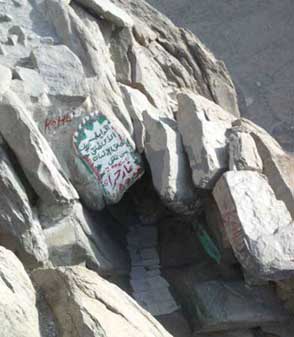
Gaare
Hira
--
I was delegated as a prophet to perfect moral virtues.
--
Good character is half of faith.
--
God is merciful to those who show mercy to others.
--
Power consists not in being able to strike another, but in being
able to control oneself when anger arises.
--
Honor your children and thus improve their manners.
--
The three best things:
to be humble amidst the vicissitudes
of fortune;
to pardon when powerful;
to be generous with no strings attached.
--
Whoever does not express his gratitude to people will never
be grateful to God.
--
The best people are those who are most useful to others.
--
Living among others is a cause for blessing, while seclusion
is the cause of torment.
--
Happy is the person who finds fault with himself instead of
finding fault with others.
--
From morning until night and from night until morning keep your
heart free from malice towards anyone.
--
A perfect Muslim is one from whose tongue and hands mankind
is safe.
--
Islam is purity of speech and hospitality.
--
Every religion has a distinctive virtue and the distinctive
virtue of Islam is modesty.
--
Greet those whom you know and those whom you don't know.
--
When asked what was most excellent in a human being, he answered,
"A friendly disposition."

Masjid
Nabvi (Sunehri Jaliyan)
--
The best of God's servants are those who when seen remind you
of God; and the worst of God's servants are those
who spread tales to do mischief and separate
friends, and look for the faults of the good.
--
Whoever believes in one God and the Hereafter, let him speak
what is good or remain silent.
--
He is the best Muslim whose disposition is most liked by his
own family.
--
Respect the guest and do not inconvenience your neighbors. The
faithful are as one person. If a man complains of a pain in
his head, his whole body complains; and if his eye complains,
his whole body complains.
--
He is not of us who is not affectionate to the little ones and
does not respect the reputation of the old.
--
Truly, the farthest seat from me on the day of resurrection
will be the garrulous, those who talk glibly, and those who
talk tall. And who is it that talk tall? The vain-glorious.
--
God is gentle and loves gentleness.
--
Inscribed on the prophet's sword:
Forgive him who wrongs you; join him who cuts you off; do good
to him who does evil to you;
and speak the truth even if it be against yourself.
--
Whoever restrains his anger when he has the power to show it,
God will give him a great reward.
--
Backbiting is more grievous than adultery,
and
God will not forgive the backbiter until the one wronged has
forgiven him.
--
Keep yourselves far from envy, because it eats up and takes
away good actions as
fire consumes and burns the wood.
--
What actions are most excellent?
To gladden the heart of a human being,
to feed the hungry, to help the afflicted,
to lighten the sorrow of the sorrowful, and to remove the wrongs
of the injured.

Seal of Hazrat Mohammad Mustafa Sallalla Hu Alaihewalsm
-----------------------------
Our
Prophet : Enes Ibn Malik reports that a Bedouin came to the
Messenger of Allah and greeted him in the Masjid. The Messenger
of Allah asked him where he came from. The Bedouin said:"
I came from far, seeking answers to some questions".
Our master told him to ask his questions:
"I
wish to be an intelligent man, what should I do?"
Holy Prophet replied, "Fear Allah".
"I
wish to be a loyal servant to Allah and do what He wants me
to do?"
Holy
Prophet replied, "Read the Quran."
"I
wish to be enlightened and have peace of heart?"
Holy Prophet replied, "Remember
Death".
"I
wish to be protected against enemies?"
Holy Prophet replied, "Trust in
Allah".
"I
wish to follow the Straight Path?
" Holy Prophet replied, "Do
good to others for Allah's sake".
"What
should I do so that Allah does not abase me?"
Holy Prophet replied, "Do not respond
to the desires of your flesh".
"I
wish to have a long life?"
Holy Prophet replied, "Praise and
thank Allah".
"I
wish for prosperity?"
Holy Prophet replied, "Be in a state
of ablution at all times".
"How
can I save myself from the hellfire?"
Holy Prophet replied, "Protect your
eyes and your tongue and your hands and what is below your waistline
against evil".
"How
can I cleanse myself from my sins?"
Holy Prophet replied, "Shed tears
for what you have done and repent by undoing what you have done
wrong".
"I
wish to be a respectable person?"
Holy Prophet replied, "Then don't
ask for anything from anybody".
"I
wish to be honorable?"
Holy Prophet replied, "Then don't
divulge the wrong doings of anybody".
"What
should I do to protect myself from the tortures of the grave?"
Holy
Prophet replied, "Recite the Surah Mulk".
"What
should one do to be rich?"
Holy Prophet replied, "Read the
Surah Muzammil".
"How
should I calm my fear of the day of last judgment?"
Holy Prophet replied, "Remember
Allah before you eat anything and before you sleep".
"What
should I do to feel the presence of Allah when I make my prayers?"
Holy Prophet replied, "Give the
utmost care in taking your ablutions and in being clean and
pure".
-----------------------------
PROPHETS & THEIR AGES :-
Hazrat Idrees (Alaihi Salaam) :
Three-hundred and fifty-six (356) years
Hazrat Nooh (Alaihi Salaam) (Noha) : Nine-hundred
and fifty (950) years
Hazrat Hud (Alaihi Salaam) : Two-hundred
and sixy-five (265) years
Hazrat Saaleh (Alaihi Salaam) : Five-hundred
and eighty-six (586) years
Hazrat Ayyoob (Alaihi Salaam) : One-hundred
and forty-six (146) years
Hazrat Shoayb (Alaihi Salaam) : Eight-hundred
and eighty-two (882) years
Hazrat Ibraaheem (Alaihi Salaam) : One-hundred
and ninety-five (195) years
Hazrat Sulaimaan (Alaihi Salaam) : One-hundred
and fifty (150) years
Hazrat Zakariyya (Alaihi Salaam) : Two-hundred
and seven (207) years
Hazrat Ya'qoob (Alaihi Salaam) : One-hundred
and thirty-nine (139) years
Hazrat Moosa (Alaihi Salaam) : One-hundred
and twenty-five (125) years
Hazrat Ishaaq (Alaihi Salaam) : One-hundred
and twenty (120) years
Hazrat Haaroon (Alaihi Salaam) : One-hundred
and nineteen (119) years
Hazrat Ismaaéel (Alaihi Salaam) : One-hundred
and thirty-seven (137) years
Hazrat Yuusuf (Alaihi Salaam) : One-hundred
and ten (110) years
Hazrat Yahya (Alaihi Salaam) : Ninety-five
(95) years
Hazrat Muhammad (Sallallaahu Alayhi Wasallam) : Sixty-three
(63) years
|


