|
||||||||
|
Indian Dargahs Intl. Dargahs Hadees Namaaz Silsila Sacred Sites Masjid Gallery Dargah Gallery Search Forums Home |
||||||||
| Latest News from South Asia : | ||||||||
THE
small jetty looks like a downgraded bus stop. People sit on stone benches, lean
against the wall and some simply stand as they wait. Their eyes do not restlessly
gaze at the other bank of the river nor do they seem to eagerly anticipate the
arrival of the boat. There is no sense of hurry or impatience. When you scan around,
you see mundu, bedi umbrella, boats, verdant green and the red flags.
This dot of a space seems like a fractal version of the larger State, Kerala.
The wide Bharathapuzha, which meets the sea a few hundred metres away, fixes the
place geographically. The history that has accrued gives it specificity. The name
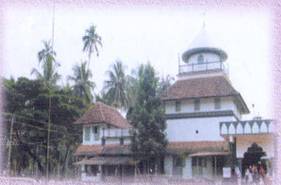
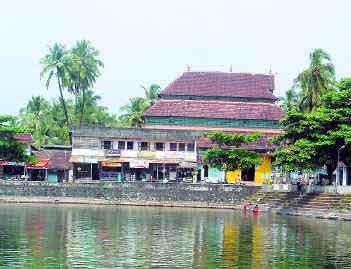
of the town is Ponnani and the place is Palli Kadavu. Palli refers to the mosque
and kadavu is the jetty. Palli
Kadavu is the beginning (or end?) of a fairly long street. The mosque that gives
the name to the place is something special and could be the reason, apart from
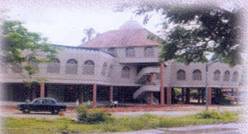
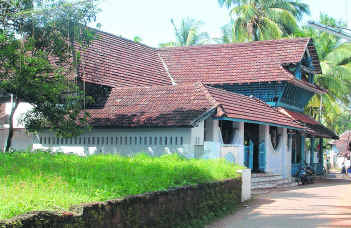
the river, to bring you here. This mosque is known as Thottungal Palli and considered
the oldest in Ponnani. At first glance, the mosque appears like a large house
and a less-informed traveller could even mistake it to be a temple. The pitched
roof, clay tiles, the decorative mogapu or front and the finials on the
ridge are very regional in their character. There are no minarets and no domes.
The call for prayers can be heard from the loudspeakers that are loosely tied
to the mogapu. Blending in A
row of old and beautiful houses lines the street. Down the road, there is another
mosque known as the Agathe Palli, built in the 15th century. One may miss this
mosque unless one is looking for it. This is partly due to the smaller scale of
the building and the way it sits on the street. The mosques, including the one
at the kadavu, are not viewed head on. They are aligned with the sides
of the street and are like any other building that front the street. Their architecture,
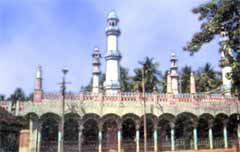
too, does not stand out but rather weave with other buildings. But the Valia Juma
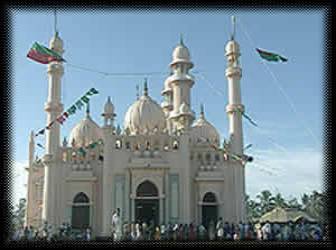
Masjid in Ponnani is an exception in terms of scale. This mosque is little larger
than the other two, but the architectural language is similar. William Logan,
the historian, thinks that the structure was built in 1519 A.D. In this mosque,
near the Mihrab - arched niche facing the direction of Mecca - one can find a
brass lamp as in a temple. Similar to the temple tanks, the mosque also has a
large tank outside and is open to people.
Kerala
has been a gateway, a place where many cultures and ideas arrived and flourished.
Active trade existed between Arabia and Kerala and the Muslims dominated the trade.
The kings of Kerala welcomed people to stay and granted them economic and religious
security. Traders from Baghdad, Yemen and Bahrain had settled in many ports of
Kerala and traded in spices and wood. By the end of the Seventh century, Islam
reached the shores of Kerala through its traders. Christianity and Judaism had
reached the place before Islam and enjoyed peaceful co-existence. For long, different
religions spread in a non-aggressive manner. Local communities, both the lower
and upper castes, took to the new ideas and converted to the new religion for
various reasons. In turn, Islam that spread in Kerala assimilated the local culture.
Cultural negotiations At
one level, the Mapillas, Muslims of north Kerala, had invented Arabic Malayalam
and engaged the local language through Arabic. At another level, they followed
social customs like Marumakkathayam or the matrilineal system prevalent among
communities like the Nairs. Customs like tying thali or mangal sutra,
dowry system and other rituals were assimilated into Muslim culture. The architecture
of the mosques was embedded in this negotiation and assimilation. The
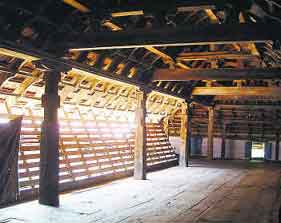
many-pillared prayer hall resembles the earlier typology of hypostyle mosques
that are known for their rows of columns. It is certainly related to the pillared
halls of temple and palaces and grew out of the local methods of construction.
The forms, architectural details and the material used are very much local. Nowhere
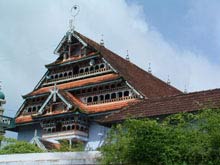
is this notion of assimilation more exhibited than in the Jama Masjid, Kozhikode.
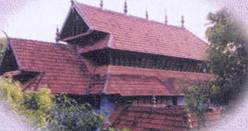
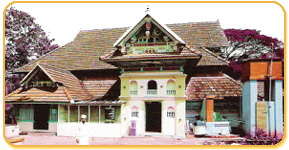
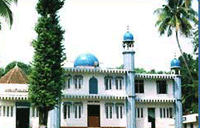
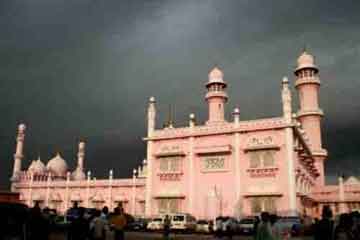
In the Thekkepuram area of Kozhikode are centuries-old mosques - Miskal , Jama
Masjid and Muchendi. Unlike Ponnani, the Jama Masjid in Kozhikode does not appear
prominent. It is larger in size but it is laid along the street and only the two-storied
porch engages the street prominently. The
entrance porch of Jama Masjid is warm and welcoming with platforms on either side.
For a moment you think you have stepped inside a house. The wooden plank on the
platform is many inches thick and the columns are solid wood sculpted in geometrical
forms. The ceilings are ornate with floral motifs. Above the ornate relief, the
verses of Quran are etched. Mohammad Koya, the Valia Qazi of Kozhikode, reads
aloud the inscription on the wooden panel above the entrance. The inscription
refers to the later addition and expansion of the mosque. The addition and the
original core are seamlessly stitched.
As
the Kazi fondly wraps the wooden column with his hand and recalls the contribution
of the Muslims of Kerala, diffused light from the wooden trellis washes his small
office in the first floor. The first floor is used for classes and short stays.
The space is spartan but the wood is sumptuously used. It is the rich details
of the wooden construction that are revealed as an ornament. There are no religious
symbols and representations in this floor. The spatial quality resembles the large
wooden houses of Kerala. The
history of Kerala dramatically changed with the advent of Portuguese in the 17th
century. The Portuguese unleashed violence to wrest control of trade from the
Muslims. The amicable relationship and the alliance between the Mappilla Muslims
and the Zamorins changed. The story of the Mapillas in the colonial period and
after is a different story to be told elsewhere. Beginnings and continuities The history of Kerala mosques, for
that matter the history of mosques in India, is believed to start with the Kodungallur
mosque. It is associated with the legend of King Cheraman Perumal, his pilgrimage
to Mecca and meeting with the prophet and conversion to Islam. If this legend
is about beginnings, the story of Mossakaka, the influential trader at Tellicherry
and his deft handling of the colonisers, is about continuity. Mossakaka was intelligent
and wealthy enough to convince the East India Company to sell their sugarcane
garden within the city so that he could build the Odathil mosque. Between these
two legends passed thousand years, but the traditions and the architecture that
sprang from them exhibit a spirit of continuity and assimilation. Hazrat
Syedina Malik Ibn Dinar ( Razi Allahu Thaala Anhu ) and 11 others
who were the followers of Prophet Muhammad, the Prophet of Islam,
first landed in Kodungallur in Kerala when they came to India.
Islam received royal patronage in some states here, and later
spread to other parts of India. He was gifted a defunct Jain
temple by the local ruler, where he established the first mosque
in the Indian subcontinent. The exact date of its establishment
is not known but is believed to be in 629 CE. Though, generally
it is considered to be the second mosque of the world to make
Jumma Prayer after the mosque in Medina, Saudi Arabia. His missionary
team then went on to built 10 other mosques along the Malabar
coast including the ones at Kollam, Chaliyam,Pantalayini Kollam/Quilandi,
Madayi/Pazhayangadi, Srikandhapuram,Dharmadom, Kasaragode,Mangalore
and Barkur. Some reports suggest that the ancient mosques at
Chombal, Kottayam,Poovar and Thengapattanam were also built
during this time. After
the fall of Chola Dynasty, the newly formed Vijayanagara Empire
invited the Seljuk Turks from Ottoman Empire from the Fractions
of Hanafi (Known as Rowther in South India) for trade link in
1279 AD, then biggest armada of Turks traders and missionaries
settled in Tharangambadi (Nagapattinam), Karaikal, Muthupet,
Koothanallur and Podakkudi. Turks (Rowthers) were unable to
convert Hindus in Tanjore regions. The Turks settled in this
area's with their armada and expanded to a moderate size of
Islam community with population of almost 1 million Rowthers.
These new settlements were now added to the Rowther community.
Hanafi franctions having fair complexions because they were
more closely connected with the Turkish than others in South.
There are some Turkish Anatolian and Turkish Safavid Inscriptions
found in wide area from Tanjore to Thiruvarur and in many villages,
inscriptions seized by Madras Museum and available for public
viewing. You may contact Archeologic Division [II] at Madras
Museum, for viewing and further research. Later
in the 1300 AD Arabs settles in the areas of Nagore, Kilakkarai,
Adirampattinam, Kayalpatnam, Erwadi and Sri Lanka this peoples
may have been the first Shafi Fractions (Known as Marakkar in
Far South and Coastal area of South India) community of Islam.
Shafi Fractions also have mixed fair and darker complexion because
they were more closely connected with the Arabs than others
in South. Arab traders also opened many new villages in these
areas and settles. Intensive missionary activities were carried
out along the coast and a number of natives like Malaya and
Indonesia also embraced Islam. Arabs (Marakkar's) missionaries
marries local women's and convert them to Islam. This conversion
made Marakkars to be a very big Islamic community of almost
2.5 million peoples. Prominent Sunni Madresas in Kerala ( sunni madrasas) Al-Kulliatul Arabia Ehyaus
Sunnat Makhdumabad, Post Athukangal, Dist. Malappuram,
Kerala - 676528. Anwaria Arabi College
Potachera, Post Nailaya, Cherplassery, Dist. Palacada,
Kerala Darus Salam Arabi College
Naandi, Calicut, Kerala. Jamia Nooria Arabi College
Faizabad, Post Patikakad, Printhal
Manna, Dist. Malappuram, Kerala - 679325 Jamia Sadiya Arabia Sa-adabad, Post Kalanad, Kasaragod, Kerala - 671317
Tel.: (0499) 2437216/2437841 K.M.M. Arabic College
Pothanpal, Post Piurampadpu, Dist. Malappuram,
Kerala - 2676528. Markazu Ssaquafathi Ssunnia
Karanthur, Calicut, Kerala - 673571
Some other places of the Dargahs in Kerala is as follows:- 1) Mamburam ( Tiroorangadi), Malappuram District 2) Puthenpally Noonakkadavu , Eramangalam, Malappuram District 3) Kakkidippuram, Malappuram District 4) Monnakel , Valanchery, Malappuram District 5) Maadin, Hazrat Khaleel Thangal Mel Muri Salath Nagar, Malappuram 6) Kuttippuram, Achipra Thangal, Malappuram District 7) Markaz , Karanthoor, Calicut District 8) Kadalundi, Jamalullaily Thangal, Calicut District 9) Quilandi, Parappally ( on Mountain ), Calicut District 10) Shaduli Thangal, Mamukkoya , Hazrat Uppappa, Calicut District 11) Parapalli Makham Darga in Ambalathara THE DARGAHS OF THE TABAEENS ( 11 CAMPANIONS ) OF
SAHABI-E-RASOOL HAZRATH SYEDINA MALIK BIN DINAR (RAZI ALLAHU THAALAH ANHU ) WHO
HAVE CONSTRUCTED ELEVEN MASJIDS ( MOSQUES) IN DIFFERENT PARTS OF THE KERALA ARE
NOT LISTED.
List
of Famous Dargah Shareef of Sahaba-e-Ikhram and Other Sufi Saints / Auliyas of
Kerala :- --------------------------------------------------------------------------- The Beemappalli Dargah Shareef is dedicated to Bee umma a pious Muslim lady endowed with extraordinary powers. Bee umma and her son who belong to the family of Prophet Mohammed are believed to have come here from Arabia centuries ago, to preach their religion Islam. The annual ten-day Uroos festival at Beemappalli is held in memory of Sayyidhathunisa Bee umma and her son Sayyidussaheed Maheen Aboobaker who are laid to rest here. The festival began at 8.30 in the morning of September 12th with a prayer 'Dunha' led by the religious chief Imam Jauab Abdulla Razak Maulavi on the premises of the shrine. This was followed by a ceremonial procession. The following six days saw regular religious discourses and preachings in the evenings. From September 19 to 21st cultural programmes held in the evening hours added a festive mood to the shrine. As part of the festival devotees make an offering of coins in earthern pots (kudams) which are smeared with sandal (Chandanam) paste. This ritual is called Chandanakkudam. Thousands of pilgrims travelled here in to take part in the festival. Flowers, silk cloth and oil offered here at Dargah Shareef were distributed to the devotees who visited the shrine, as is the practice. Getting
there : ---------------------------------------------------------------------------- More Muslim Festivals and Shrines in Kerala : Mumburam : Muslim shrine and receptacle for dead bodies of the Thangals (the relegious leaders of the malabar muslims), situated in A.R.Nagar village; is a major pilgrimage centre of Muslims. Valiya Juma Masjid Malappuram : This is an important pilgrim centre of the Muslims of Kerala. The four day annual festival at the mosque (nercha) is celebrated in April. Adjoining the mosque is the mausoleum of the Malappuram shaheeds (martys) whose brave exploits have been immortalised in the Mappila ballads. Situated
at a distance of 5 kms south of the capital city of Trivandrum is the prominent
Muslim pilgrim center of Beemapally. Revered and visited by people professing
and practicing all faiths, Beemapally is dedicated to Beema Beevi, a devout Muslim
lady, believed to have been blessed with holy powers. Malappuram
(Kerala) : Noted for Nercha Muslim festival. ---------------------------------------------------------------------------- MOST
FAMOUS SUFI SAINT OF SOUTH INDIA ( MODEL OF COMMUNAL HARMONY ).
******************************************************
Hazrat Tajuddin (Razi allahu anhu ) Hazrat Tajuddin (Razi allahu anhu ) was formerly King who went in search of Hazrat Nabi e kareem ( sal lalu alaihi wo salam ) ultimately the king met and embraced islam on hands of sarkar e kayenath and was named as Taj uddin (razi allahu anhu ). He sacrificed his life , kingdom and obeyed the orders of Hazrat Nabi e kareem sal lal lahu alaihi wo salam and went to different places for the cause of islam due to which he was unable to come back to kerala so he sent a letter with great sahabi hazrat Malik Dinar (Raz) after hijrat of sarkar for the construction of masjid in kerala. When hazrat Tajuddin (Razi allahu anhu ) wanted to go back to kerala his wisal took place , he was buried near port zafar ( old name ) which is now comes under oman , the place is known as salalah in oman. All
the sunni muslims of Entire Kerala and all ashiqueens around
the world have great love towards hazrat Tajuddin (Razi allahu
anhu ) and remember him as one the greatest personality who
met our beloved Prophet Sal lal lahu alaihi wo salam and went
to different places on the orders for Prophet Sal lal lahu alaihi
wo salam for the cause of islam and Hazrat Tajuddin ( Cheraman
perumal indian King ) was responsible for the construction of
the first masjid in the india by sending the letter in the hands
of great sahabi-e-rasool Hazrat Syedina Malik-bin-Dinar ( razi
allahu anhu). Information
sent by : Khaleel
Ahmed Irfani ( Khadim Dargah-e-Khwaja Lalu Bhai Qasir Chisti
( Khwaja-e-Bangalore ) & Astan-e-Irfani Hyderabad ) ,
|
|
|||||||
|
Reproduce
Only with Permission and Acknowledgments : Email us
at Indiansunni@gmail.com
|
||||||||
|
||||||||
|
|
||||||||
| Official Letters from Major dargahs : Aulia-e-hind.com Banners at Major dargahs : Achievements of Site : Meet the Team | ||||||||
|
|
||||||||
|
Now
Add New Dargahs, Upload Pictures, Ask Questions, Share Articles,
Give Suggestions and Complains Also
Visit This
website is a privately maintained Information site and does not
have any Official connection or Much
of the content on this site was sent by other users or by members,.
Site
Desinged and Hosted by Softech Solutions
|